The Mesolithic period of hunter-gatherers remains an often misunderstood yet enigmatic era in British history.
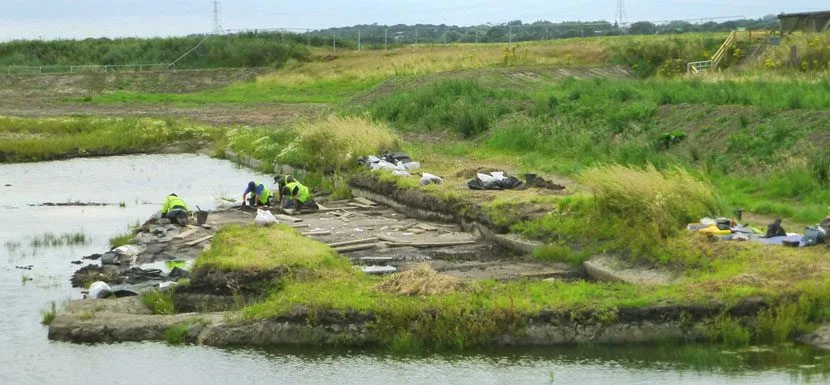
A few miles outside my hometown of Liverpool lies a tranquil nature reserve, located on a sandy spit of land in the floodplain of the River Alt. As well as being home for migrating birds, Lunt Meadows is home to one of the most important archaeological sites in the country.
The Lunt Meadow Findings
8,000 years ago, the area of Merseyside was a very different place. There were no football stadiums, and the Liver Birds were still a long way from guarding the banks of the River Mersey. The Ice Age had ended 2,000 years earlier [1] and Britain was becoming the island that we recognise today. The Mesolithic period, spanning 9,000 to 4,300 BC in the UK [2], was a time of hunter-gatherers, and Lunt was no different.
Whilst several sites from the Mesolithic period have been found across the UK, evidence of how these nomadic tribes lived has been scarce. The prevailing consensus is that these people lived in small groups that travelled around and built temporary camps [3]. That was until 2012, when the Environment Agency and Wildlife Trust were looking to create a flood alleviation scheme on some disused farmland in Lunt, a village just outside of Liverpool. During an excavation carried out before the site’s development, esteemed archaeologist Ron Cowell and his team from the Museum of Liverpool discovered something very interesting. Digging down through the different layers of flood sediment and stone tools revealed that Ron had discovered a Mesolithic settlement of astonishing importance.
As mentioned earlier, most archaeologists believed that the small tribes of people that inhabited the Mesolithic period moved about seasonally, migrating inland during the summer months and taking advantage of the marine environment for food during the colder months. It is this seasonal movement that gives rise to the name “hunter-gatherer” [4]. But Ron’s discovery brings up questions about just how mobile these people were.
What makes Lunt so special is that the buildings there show a much more permanent and organised Mesolithic settlement, unlike the transient camp not too far away at Tarbock in Knowsley. The three Lunt buildings measure an impressive 6-8 meters across and show multigenerational use, although exact dating is still to be confirmed. We can say that the site was flooded and unusable 7,500 years ago [5]. The site sat at the bottom of a shallow lake for a few hundred years before being consumed by saltwater from the nearby River Alt, which spread as far as Sefton Village, around a half a mile away. This was key to the site’s protection and survival [6].
The Wider Mesolithic Area
Locals to the Sefton area are aware that Lunt is not the only evidence of early settlers. In the dunes that line the coast, Mesolithic footprints have been found in the sands. Around 30 years ago, a set of both adult and children’s prints was uncovered by the tides. The footprints, dating from a few hundred years after the Lunt site, had been preserved in layers of mud and offer a time-limited glimpse into the lives of these people [7]. I recall hearing that the prints imply that the children were running; could they have been playing? Did their parents struggle to keep them focused on the task at hand? I love this idea and find it brings them to life for me.
Spiritual Beliefs at Lunt Meadow
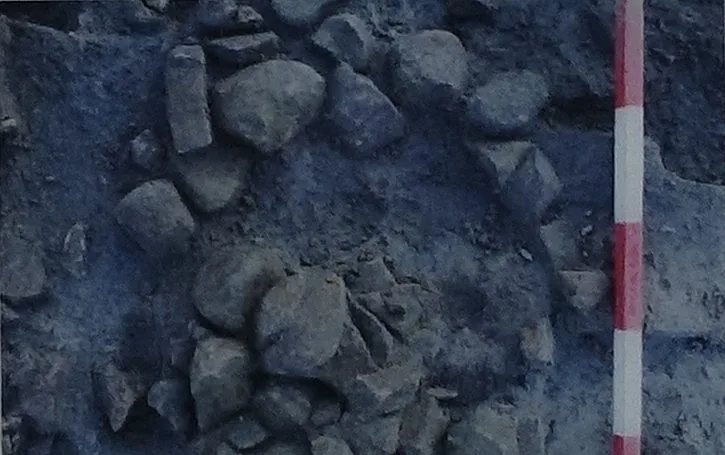
What I find very interesting is that Lunt gives us a glimpse into the possible spiritual beliefs of the Mesolithic inhabitants. At the site, they found 2 pits full of stones, one forming a neat circle and the other a more tightly packed oval made up of overlapping stones. In the centre of these circles, they found Iron Pyrite, Fools Gold, which surely must have had some significance. These pits seem to be receptacles for broken stone tools; some possibly being broken during use, and others showing signs of being broken intentionally. They were clearly placed in the pits very shortly after the breakage shown by their sharp edges, and with a lot of care and reverence. This raises the tantalising idea of offerings and sacrifice, which is reinforced by the finding of further pits in the same area of the site. Further to this, in the centre of one of the buildings, they have found the burnt remains of a tree stump. The evidence suggests that this stump had been burnt elsewhere and placed into the ground [9]. What this offering represented, the archaeologists are not sure yet, but it suggests an integrated spiritual connection between the outdoors and these people, as seen in other animistic peoples. Melon sized Mica rich Granite boulders that had been dyed red from iron-rich soil were also found buried under the huts. These boulders were surrounded by a blue flint blade and a small pebble. There were two of these flint-pebble pairs at each boulder, placed at opposite sides of the central stone [9].